By Carina Storrs
Healthcare workers have an intense workload and often experience mental distress during resuscitation and other critical care procedures. Although researchers have studied whether robots can support human teams in other high-stakes, high-risk settings such as disaster response and military operations, the role of robots in emergency medicine has not been explored.
Enter Angelique Taylor, the Andrew H. and Ann R. Tisch Assistant Professor at Cornell Tech and the Cornell Ann S. Bowers College of Computing and Information Science. She is also an assistant professor in emergency medicine at Weill Cornell Medicine and director of the Artificial Intelligence and Robotics Lab (AIRLab) at Cornell Tech.
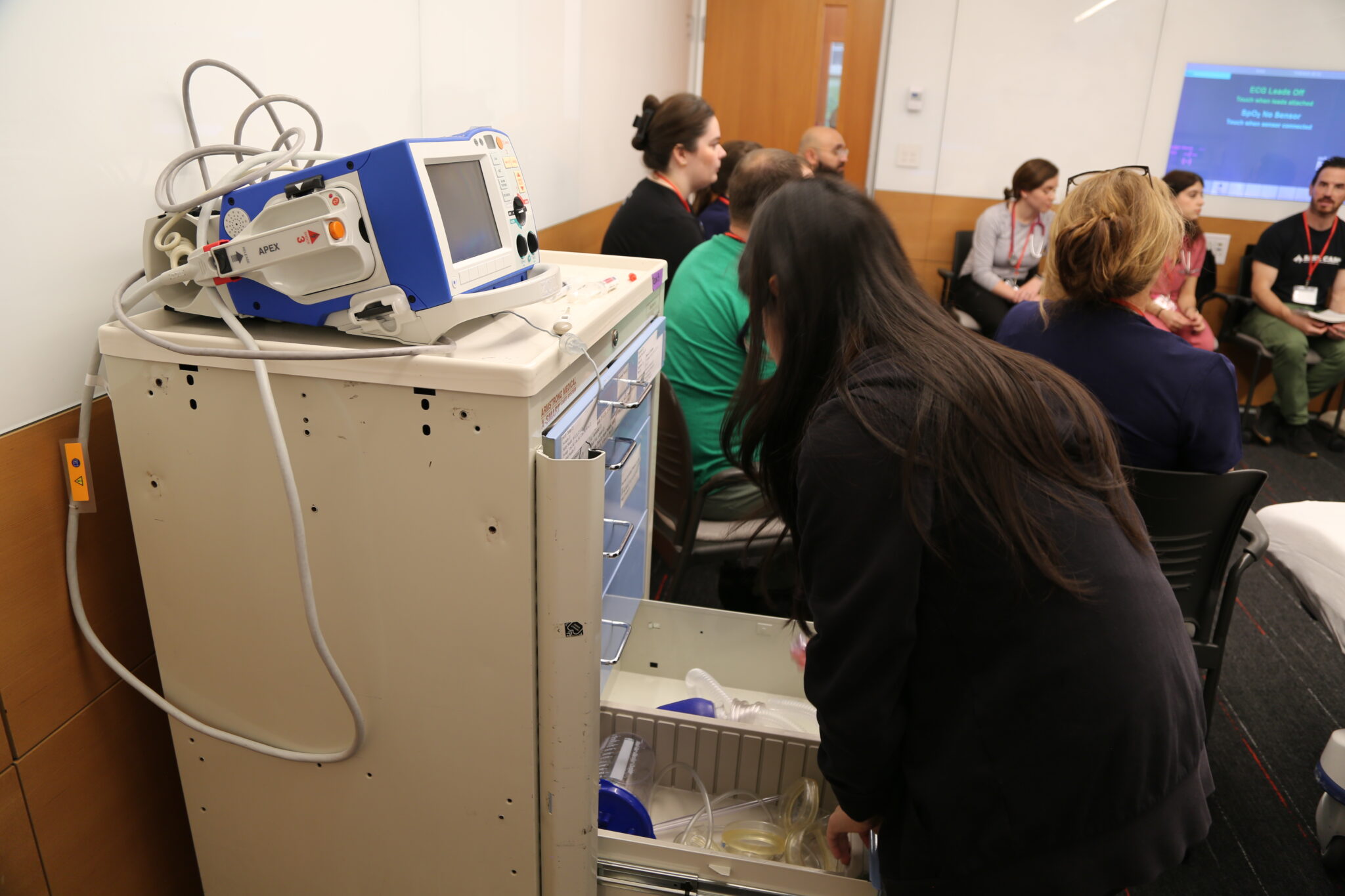
In a pair of articles published at the Institute of Electrical and Electronics Engineers (IEEE) conference on Robot and Human Interactive Communication (RO-MAN) in August 2025, Taylor and her collaborators at Weill Cornell Medicine, associate professor Kevin Ching and assistant professor Jonathan St. George, described research on their new robotic crash cart (RCC) — a robotic version of the mobile drawer unit that holds supplies and equipment needed for a range of medical procedures.
“Healthcare workers may not know or may forget where all the various supplies are located in the cart drawers, and often they’re kind of shuffling through the cart,” Taylor said. This can cause delays during emergency procedures that require iterative tasks with precise timing, exacerbating medical errors and putting patients at risk, she noted.
To create the RCC, Taylor and her team outfitted a standard cart with LED light strips, a speaker, and a touchscreen tablet integrated with the Robot Operating System. This middleware connects computer programs to robot hardware, enabling them to work together to provide users with verbal and nonverbal cues.
During an emergency procedure, a user can request the location of a supply on the tablet. Then the lights around the drawer with that supply blink, or a spoken instruction plays through the speaker. Users can also receive prompts to remind them about necessary medications and recommend supplies.
In their article, “Help or Hindrance: Understanding the Impact of Robot Communication in Action Teams,” Taylor’s team conducted pilot studies of the RCC. One pilot involved 84 participants, aged 21 to 79, about half of whom had a clinical background. Working in groups of 3 to 4, they conducted a series of simulated resuscitation procedures with a manikin patient using three different carts: a RCC with blinking lights for object search and spoken task reminders, a RCC with blinking lights for task reminders and spoken language for object search, or a standard cart.
The team found that participants preferred the RCC that provided verbal and nonverbal cues over no cues with the standard cart — rating it lower in terms of workload and higher in usefulness and ease of use.
“These results were exciting and achieved statistical significance, suggesting that the use of a robot is beneficial,” said Taylor. The article, by Taylor, Ph.D. student Tauhid Tanjim, and colleagues at Weill Cornell, was a Kazuo-Tanie Paper Award finalist, an honor given to the top three papers in their category at the conference.
In the second article, “Human-Robot Teaming Field Deployments: A Comparison Between Verbal and Non-verbal Communication,” the research team began testing the RCC under more realistic conditions. Participants were healthcare workers from across the United States, and actors played frantic family members during the simulations.
Similar to the pilot studies, Taylor, along with colleagues at Cornell and Michigan State University, found that the RCC reduced participant workload, depending on whether the robot provided verbal or non-verbal cues. However, they evaluated robots with only one type of cue, not both, and identified room for improvement, particularly in the robot’s visual cues. They are now studying healthcare workers’ impressions of an RCC with multimodal communication.
Taylor hopes that other research teams will start exploring how robots can support healthcare teams in critical care settings. To that end, Taylor and her colleague presented an article at the February 2025 Association for Computing Machinery/IEEE International Conference that offers a toolkit for researchers to build their own RCC.
Carina Storrs is a freelance writer for Cornell Tech.